



posted 12th January 2026
When you’re caring for an older relative, the focus is usually on the here and now. You’re getting through the morning routine, making sure they’ve eaten, or trying to manage a confusing appointment.
In the middle of that busy reality, money often comes up. You might hear about Attendance Allowance in passing from a friend, a GP, or a social worker. But when you’re already tired, looking into another government benefit can feel like one more job on an impossible list.
This guide is here to take the guesswork out of Attendance Allowance. What it is, who qualifies, and how it can make daily life feel a little more manageable for both you and the person you care for.

Attendance Allowance at a glance
• For people over State Pension age (currently 66 or older)
• Tax-free benefit (it doesn’t count as taxable income)
• Not means-tested (savings and income don’t usually affect eligibility)
• Based on need (not whether care is already in place)
• Worth up to 3110.40 per week in 2025/26
What is Attendance Allowance?
Attendance Allowance is a UK government benefit for people over State Pension age who need help with personal care or supervision because of a physical or mental disability.
It’s one of the most under-claimed benefits in the UK, often because people assume they won’t qualify. Unlike many other types of support, Attendance Allowance isn’t means-tested. This means it doesn’t matter how much your loved one has in savings, or what their pension income is. They may still be eligible if they need help.
At its heart, Attendance Allowance is about maintaining dignity, safety, and independence. It’s not about proving how unwell someone is.
How much could Attendance Allowance provide?
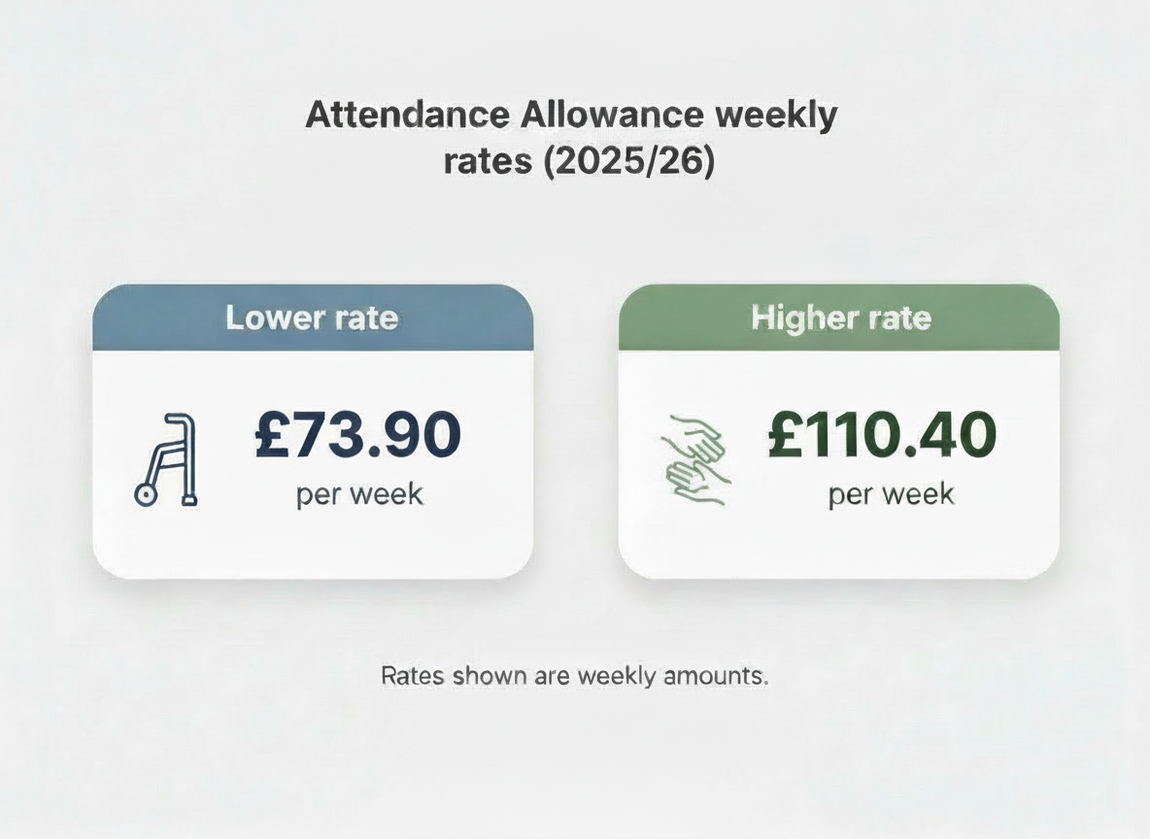
For the 2025/26 tax year, there are two weekly rates. The Department for Work and Pensions decides which rate applies based on the information you provide.
• Lower rate: £73.90 per week
Usually awarded if someone needs frequent help or constant supervision during the day, or supervision at night.
• Higher rate: £110.40 per week
Usually awarded if someone needs help or supervision throughout both the day and the night, or if they’re terminally ill.
That extra support can add up to over £3,842 or £5,740 a year. For many families, it’s the difference between coping and feeling like there’s finally a bit of breathing space.
The application process can feel clinical and long. To help you prepare, we’ve created a Free Checklist that simplifies exactly what you need to note down before you start.
But they don’t have a carer yet
One of the biggest misconceptions about Attendance Allowance is that you must already have a professional carer in place. This isn’t true.
Attendance Allowance is based on the help someone needs, not the help they’re currently receiving. Many older people live alone and quietly struggle with tasks like getting dressed, preparing meals, managing medication, or feeling safe on the stairs.
Even if your loved one is currently soldiering on by themselves, they may still qualify.
For example, we regularly speak to families in Bristol and South Gloucestershire where a parent is coping day to day but needs prompting to eat, forgets medication, or feels anxious and unsafe at night. Many of these families successfully claim Attendance Allowance before any formal care begins.
How can Attendance Allowance be used?
There are no restrictions on how Attendance Allowance is spent. The money doesn’t have to go directly to a care agency.
Families commonly use it to:
• Pay for a few hours of home care or companionship each week
• Cover higher heating bills to keep the home warm
• Pay for taxis to medical appointments or the shops
• Hire a cleaner or gardener to reduce physical strain
It’s about using the allowance in whatever way best supports independence and wellbeing.
Some families use it to start with a small amount of home support in Bristol, click here to find out more.
Common hurdles, and how to clear them
The Attendance Allowance application form is long and can feel quite clinical. It asks about things like bodily functions and supervision, which many families find uncomfortable.
A key tip is to focus on a bad day. As family members, we naturally focus on what our parents can do. But for this form, it helps to be honest about where they struggle.
A gentle way to think about it is this: if a stranger had to step in tomorrow, what would they need to help with to keep your loved one safe and comfortable?
Here are a few prompts that can help:
• Do they need prompting to eat or drink?
• Do they get confused with medication?
• Do they need help getting out of a chair or using the toilet?
• Do they need supervision to stay safe?
Every yes isn’t a failure. It’s a sign that your loved one deserves extra support.
If dementia is part of what's going on, dementia-friendly help at home can make day-to-day life feel steadier, click here to find out more.
How to start an Attendance Allowance claim
If you think your loved one may be eligible, the easiest way to begin is to call the Attendance Allowance helpline on 0800 731 0122. You can also apply for Attendance Allowance on GOV.UK.: https://www.gov.uk/attendance-allowance
A practical tip: if you request a form by phone, the claim is usually backdated to the date of your call, provided the form is returned within six weeks. If you download the form online, payments usually only start from the date it’s received.
Our approach at Your Care South West
At Your Care South West, we see every day how much a difference Attendance Allowance can make.
For some families, even the lower rate can help cover a couple of hours of support each week. That can be enough to take the pressure off, bring a bit of routine back, and help your parent stay safe and steady at home.
We specialise in introducing families to self-employed carers who offer unhurried, personal support. Whether care is funded through savings or Attendance Allowance, we believe care should always feel simple, respectful, and human.
If you’d like to talk through whether Attendance Allowance could help cover the cost of regular care, or if you simply want reassurance that you’re on the right track, we’re here to help.
Call us for a chat on 0117 947 7422.
Ready to start? Don't forget to download our Attendance Allowance Checklist to help you keep track of 'bad day' examples and backdating tips