



posted 13th May 2026
When “Just a Cleaner” Isn’t Enough: Spotting the Little Signs an Older Parent Needs More Support
Most families do not begin their journey looking for care.
In fact, many actively avoid the word altogether.
They are not searching Google for “elderly support services” or “home care packages.” They are trying to solve what feels like a practical problem.
"Mum seems more tired lately." "Dad’s house is not as tidy as it used to be." "The washing keeps piling up." "The fridge is empty again." "The same unopened post is sitting on the sideboard week after week."
Something feels slightly “off,” but nobody can quite explain why.
So the family does what most families naturally do.
They look for a cleaner.
And on the surface, it makes perfect sense.
A cleaner feels safe. Manageable. Non-invasive.
It does not feel like “care.”
For the Sandwich Generation - those balancing careers, children, relationships, finances, and ageing parents all at once - this feels like the easiest first step.
But here is what many families do not realise until much later:
The earliest warning signs of decline are rarely about the property.
They are about the person.
And the little things families dismiss today often become the big crises they are desperately trying to avoid tomorrow.

Decline Rarely Arrives Dramatically
One of the biggest misconceptions around ageing is that decline happens suddenly.
People imagine a dramatic turning point. A serious fall. A hospital admission. A diagnosis. A moment where it becomes undeniably obvious that support is needed.
But in reality, most decline happens slowly and quietly.
It arrives in fragments.
A missed meal here. A forgotten appointment there. An unpaid bill. A reluctance to go upstairs. A subtle loss of confidence in the kitchen. A growing pile of unopened mail.
Decline whispers long before it shouts.
The problem is that because each individual change appears small, families naturally explain them away.
“She’s just getting older.” “He’s always been forgetful.” “She’s probably just tired.” “He’s always hated cooking.”
Meanwhile, the older person themselves is often working incredibly hard to hide how much they are struggling.
Many older adults fear becoming a burden. They fear losing independence. They fear being forced into decisions they are not emotionally ready for.
So they adapt quietly.
They stop using certain rooms. They wear the same clothes repeatedly because laundry feels overwhelming. They stop inviting people over. They avoid cooking proper meals. They minimise difficulties during phone calls.
And because families are often stretched thin themselves, these subtle changes can remain unnoticed for months.
This is exactly why early observational support matters.

The Changes Families Often Miss
Most adult children see their parents in snapshots.
An hour on a Sunday. A quick visit after work. A rushed phone call between school runs and meetings.
During that short window, many older people present the best version of themselves.
They tidy before visitors arrive. They say they are “fine.” They laugh things off. They mask confusion.
What families see is often a carefully managed version of reality.
But observational support reveals the moments in between.
This is where the difference between a cleaner and a Home Helper becomes critical.
A cleaner’s focus is the environment.
A Home Helper’s focus is wellbeing.
That difference changes everything.
Because the earliest signs that somebody is struggling are often behavioural, emotional, physical, or cognitive rather than practical.
At Your Care, our Home Helpers are trained to notice subtle changes that families may never spot during short visits.
Furniture Walking
Using tables, counters, walls, or doorframes for balance instead of walking confidently through the home.
Often, this appears long before a major fall happens.
Tactile Hesitation
A pause when using familiar appliances. Confusion with the kettle. Forgetting how to use the microwave. Standing in the kitchen unsure what they were doing.
These moments can indicate reduced confidence, cognitive changes, or exhaustion.
Wardrobe Repetition
Wearing the same outfit for several days. Not because they want to. But because washing clothes, choosing outfits, or managing routines has become mentally overwhelming.
Social Withdrawal
Becoming quieter during conversations. Avoiding eye contact. Speaking less. Stopping hobbies. Cancelling plans.
Often, people withdraw socially to hide memory lapses, hearing difficulties, or declining confidence.
Subtle Bruising
Small bruises on arms, hips, or legs. The “near miss” falls nobody talks about. The slips they dismiss as clumsiness.
These are frequently early warning signs of mobility decline.
Food Changes
Milk going out of date. Freezers filled with ready meals. Empty cupboards. Repeated takeaway packaging.
Nutrition is often one of the first areas to deteriorate when somebody is struggling emotionally, cognitively, or physically.
Why the “Cleaner” Model Fails Vulnerable Seniors
Cleaners provide an incredibly valuable service.
But they are not trained to assess wellbeing.
Their role is task-focused.
Hoover the stairs. Clean the bathroom. Change the bedding. Polish the surfaces. Move to the next house.
And when somebody is vulnerable, task-only support can leave dangerous gaps.
If your parent seems confused that morning, has not eaten, is becoming forgetful, or appears emotionally withdrawn, a cleaner may not have the training, confidence, or remit to recognise the significance of those changes.
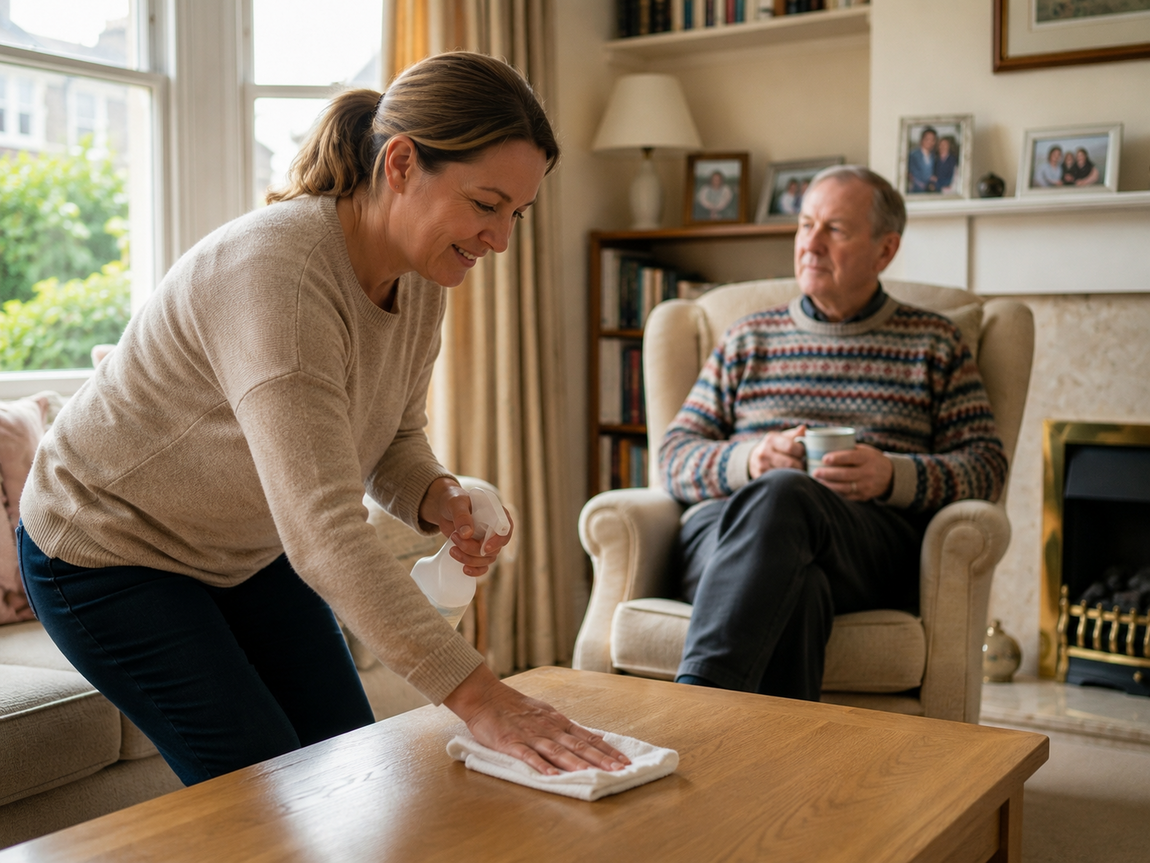
A Home Helper looks beyond the task list.
The Property
Cleaners just clean the home. They only notice dust, clutter, laundry, and cleanliness.
The Person
Home Helpers observe not just the individual, but also the home. They notice mood, mobility, confidence, appetite, memory, and routine changes. As well as, laundry, cleanliness, dust and clutter.
The Bridge
Early observation creates early intervention, often preventing avoidable hospital admissions or crisis situations.
The difference may seem subtle.
In reality, it can completely change the trajectory of somebody’s later life.
Because prevention rarely looks dramatic.
Sometimes prevention is simply noticing the small things early enough.

The Hidden Cost of “Managing Alone”
There is an entire generation of older people who were raised to keep going no matter what.
They learned not to complain. Not to ask for help. Not to burden others.
So they continue managing privately long after life has become difficult.
This is especially common after bereavement.
When somebody loses a spouse, it is rarely just emotional.
The entire structure of daily life changes.
One person may have always managed the finances. The other may have always cooked. One may have handled appointments. The other the cleaning.
Suddenly, everyday life becomes cognitively and emotionally exhausting.
Tasks that once felt automatic now feel overwhelming.
But pride keeps many people silent.
And for the Sandwich Generation, the emotional toll becomes enormous.
Adult children often carry a constant low-level anxiety:
“Are they eating properly?” “What if they fall?” “Should I be doing more?” “Am I missing something?” “How long can this continue?”
Many are already juggling:
• Full-time jobs
• Financial pressure
• Teenagers or young children
• Relationship responsibilities
• Burnout
• Guilt
• Mental exhaustion
What starts as “just helping Mum out a bit” can quietly become an unsustainable emotional load.
This is why Home Help is not simply about practical assistance.
It is about reducing risk before crisis.
It is about emotional reassurance.
It is about knowing someone observant, compassionate, and professionally trained is regularly checking in on the details that matter.
You are not just paying for cleaning hours.
You are investing in:
• Early observation
• Continuity
• Emotional reassurance
• Reduced isolation
• Safer independence
• Preventative support
• Peace of mind
Independence Is Not the Absence of Help
One of the most damaging myths around ageing is the belief that independence means doing absolutely everything alone.
It does not.
Real independence means:
• Staying safe
• Remaining comfortable
• Maintaining dignity
• Having choice
• Protecting routines
• Staying connected
• Remaining in control of your life for longer
Ironically, accepting support early is often exactly what protects independence later.
Families frequently tell us:
“She won’t accept a carer.”
And honestly, we understand why.
For many older adults, the word “care” feels frightening. Clinical. Final.
That is why we start with the little things.
A helping hand around the home. A cup of tea and conversation. Support with meals. Laundry. Shopping. Gentle companionship.
No uniforms. No rushing. No clinical feeling.
Just practical support from a warm, familiar face.
Over time, trust builds naturally.
And if deeper care is ever needed later, the relationship already exists.
That transition becomes far less distressing because support no longer feels like a stranger entering the home.
It feels familiar. Safe. Trusted.

The Little Things Matter More Than You Think
Most crises in later life do not appear overnight.
They build quietly through weeks or months of unnoticed struggles.
The missed meals. The increasing isolation. The near falls. The confusion. The exhaustion. The gradual loss of confidence.
By the time families finally say, “Something has suddenly gone downhill,” the signs have often been there for much longer.
That is why the little things are rarely little.
And that is why the right kind of early support can make such a powerful difference.
Home Help & Wellbeing Support
Supporting families across Bristol & South Gloucestershire
If you have started to notice the little things, the unopened post, the empty fridge, the missed meals, the laundry piling up, or the quiet feeling that something is not quite right, it may be time to explore gentle support at home.
At Your Care, our Home Helpers provide warm, practical and observant support that helps older people remain safe, comfortable and independent for longer.
Whether your loved one needs help around the home, companionship, meal support, shopping, or someone trusted to notice the small changes that matter, we are here to help.
To speak with our team, call 01179 477422 or click here to request a call back.