



posted 25th November 2026
Dementia and refusing to get up: what can help?
If someone living with dementia keeps refusing to get up, wash or get dressed, the problem is often the question, not the person. Questions like "Do you want to get up?" make it easy to say no. Acknowledging how they feel, then offering a choice between two good options, such as "Shower before breakfast or after?", usually works far better.
Why does someone with dementia refuse to get up in the morning?
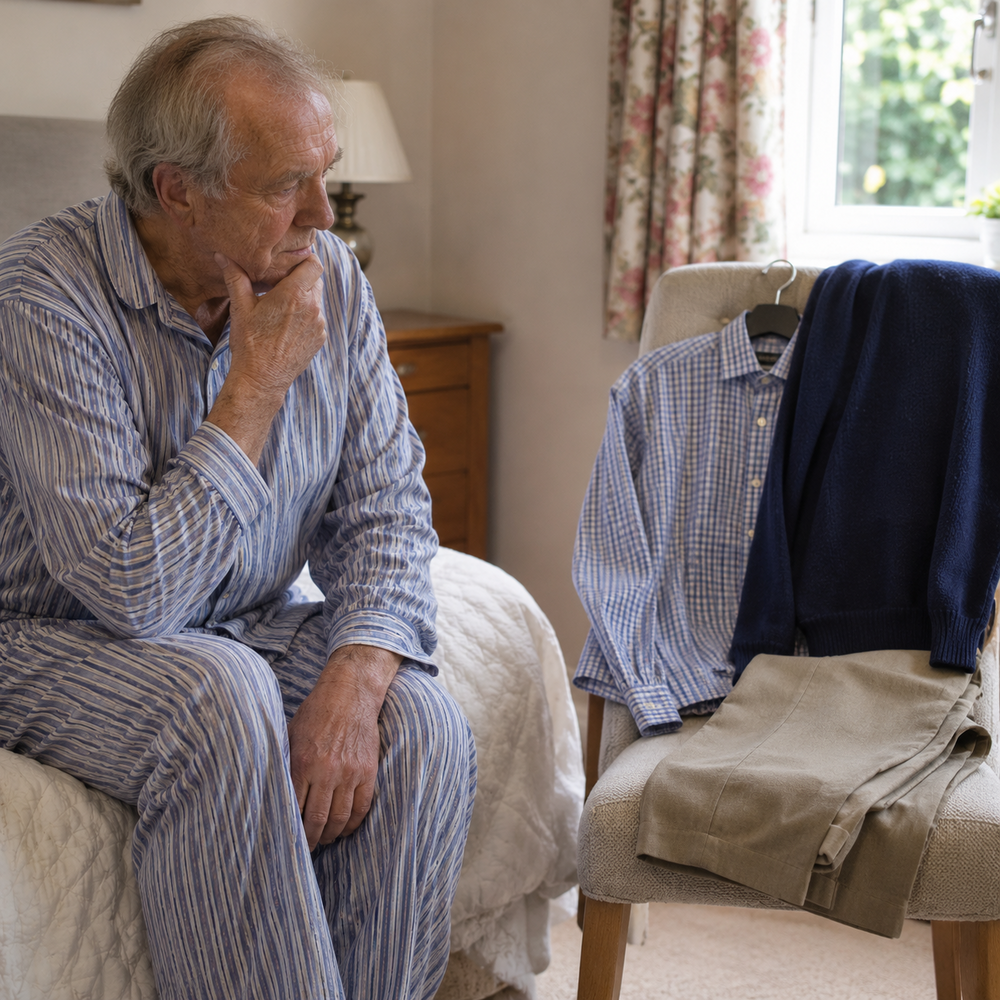
Getting up and ready involves lots of small decisions: getting out of bed, which clothes, which sleeve, what comes next. Dementia makes each step take more thinking, so a morning routine can quickly feel like too much.
When someone feels rushed or unsure, that turns into worry, and worry often comes out as "no".
It isn't stubbornness, and they aren't being difficult. Mornings can also be a very different time of day for someone living with dementia, which we explore in why an older parent can seem fine in the morning but struggle later.
The question that kept getting a "no"
So what helps? One of our favourite stories this year shows just how small the change can be.
Our Care Consultant, Mollie MacRae, has more than 12 years of experience in care. She's often the first person our PAs call when something isn't working, and she never makes anyone feel silly for asking. She'd much rather stand beside someone and show them another way.
A lady living with dementia kept refusing to get out of bed in the morning. Her PA was doing everything she could, but most mornings ended in a standoff, and both of them were finding it hard.
Mollie joined the PA at the next visit to see whether a fresh pair of eyes could help. At first she just watched, and she noticed something small but important. Every question the lady was being asked could be answered with one word: "no". Something like "Do you want to get up now?" or "Shall we have a shower?" And each "no" brought the morning to a stop.
So Mollie tried a different approach. She acknowledged how the lady was feeling, kept everything positive, and offered choices rather than yes or no questions. Something like "Would you like your shower before breakfast or after?" Before long, the lady was up and in the shower.
Then came the part Mollie is best at. Rather than simply handing over the answer, she talked it through with the PA afterwards and asked what she'd noticed had changed. At the next visit, the PA did it all herself.
Mollie didn't just fix one morning. She shared what she knew, so it worked every morning after that.
It's this way of working that made Mollie a finalist for the Workforce Development Award at the South West Great British Care Awards on Thursday 19th November, on her birthday, no less. She didn't bring the trophy home, but we had a brilliant night and we couldn't be prouder of her. Thank you to everyone who cheered her on, and congratulations to all the winners!

How can I help someone with dementia get up and ready in the morning?
You don't need to be a care professional to use Mollie's approach. Here's what families can try at home:
- Listen to your questions. If they can be answered with "no", there's a good chance they will be.
- Offer a choice between two good options. "The blue cardigan or the pink one?" works better than "Do you want to get dressed?" Two choices is plenty. Too many can feel overwhelming, as we explain in dementia, choices and decision making.
- Acknowledge how they feel first. "It's chilly this morning, isn't it? Let's get you warm." Feeling understood makes it much easier to say yes.
- Keep it positive and unhurried. Leave more time than you think you need. Rushing is one of the most common reasons a morning goes wrong.
- Don't force it. If it's still a no, leave it for ten minutes and try again with a different approach. Our blog on dementia support: understanding, not forcing explains why.
- Make washing feel safe and comfortable. A warm bathroom, a towel ready and one step at a time all help.
Frequently asked questions
Should I make someone with dementia get out of bed?
Try not to. Forcing usually makes things worse and can damage trust. Acknowledge how they feel, offer a simple choice, and if it's still a no, give it ten minutes and try again.
What if refusing to get up is new or sudden?
Mention it to their GP. A sudden change can have a physical cause, such as pain, an infection or poor sleep, so it's always worth checking.
How long should a morning visit be for someone with dementia?
We believe an hour. A 30-minute visit often means rushing, and rushing is exactly what makes mornings harder. An hour gives time to get up at their own pace, wash, dress and have breakfast together.
Help with mornings in Bristol and South Gloucestershire
Sometimes, even with all the right approaches, mornings are still too much to manage alone. That's where we can help.

Your Care is a family-run team, founded by Tina in 2014, specialising in dementia support at home across Bristol and South Gloucestershire. Our morning visits are a full hour, with the same familiar face each time and people who understand dementia, like Mollie. It's why our award-winning team was named joint Organisation of the Year at the Bristol Dementia Awards in October.
Right now we have a few 9am to 10am morning visits free, Monday to Friday. Give us a ring on 0117 947 7422 (Monday to Friday, 9am to 5pm), or find out how our free telephone consultation works.
And if you'd like more ideas like this one, our book After the Diagnosis: Your Guide to Living with Dementia covers the first year after a diagnosis.